
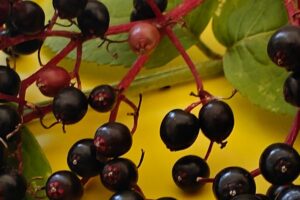
It is at this time of the year (mid to late August) that we enjoy the sun, the hot weather, being outdoor… The flu season doesn’t even enter our minds… But of course it is just around the corner and now is the perfect time to arm ourselves with a great flu remedy that nature so generously provides. I am talking Elderberry remedies – I have been making it for years at this time of the year and come winter gifting it to friends and family around me. Now is the time to harvest the berries and make Elderberry Syrup, tincture, or gummies. In this post you could find probably more than you would want to know about how it works and how to make it.
Above is an audio overview and a slide deck of the the Elderberry book which is free to download below
How Elderberry inhibit viral replication in the body?
Black elderberries (Sambucus nigra) contain a dense complex of polyphenols, vitamins, organic acids, and proteins that drive their antiviral, antioxidant, and immune-modulating properties. Elderberry anthocyanins and lectins combat viral infections through a multi-target mechanism that disrupts early entry, viral replication, and viral release.
Blocking Viral Entry
To infect a cell, influenza relies on its surface glycoprotein, hemagglutinin (HA), to bind to sialic acid receptors on human respiratory epithelial cells.
- Anthocyanin Binding: Flavonoids like cyanidin 3-sambubioside physically attach to the external domain of the viral HA spikes. This creates steric hindrance, directly preventing the virus from docking onto the sialic acid receptors of host cells.
- Lectin Receptor Competition: Sambucus nigra agglutinins (specifically SNA-I) selectively target and bind to $\alpha$-2,6-linked sialic acid residues—the exact surface markers human influenza viruses target. By coating these cellular docking sites, lectins competitively block viral attachment.
Viral Envelope Disruption & Internalization Inhibition
If a virus manages to attach to the cell surface, elderberry compounds interfere with the subsequent steps of cellular entry and uncoating:
- Membrane Rigidification: Anthocyanins incorporate into the lipid bilayer of enveloped viruses (like Influenza A and B), decreasing membrane fluidity. This prevents the virus from undergoing the conformational changes needed to fuse its envelope with the host endosomal membrane.
- Inhibition of Endocytosis: Research indicates that elderberry extract reduces the rate of viral endocytosis, leaving virions exposed to extracellular immune surveillance for longer periods.

Elderberry
From Ancient Roots to
Modern Relevance
Elderberry is a Free to download
digital book in pdf format.
It is drawing on centuries of documented use and emerging research, the book explores the remarkable chemistry behind elderberry’s healing power
and a lot more.
Preventing Viral Spread
Once an infected cell produces new viral particles, the virus relies on another enzyme, neuraminidase (NA), to cleave sialic acid bonds and release fresh virions to infect neighboring cells.
- Active Site Blockade: Elderberry flavonoids (including quercetin and cyanidin derivatives) bind near the enzymatic active site of neuraminidase.
- Tethering Virions: By inhibiting NA activity, newly replicated virions remain stuck to the surface of the dying host cell, preventing the exponential spread of the virus throughout the respiratory tract.
Immune Modulation & Cytokine Regulation
Beyond direct interactions with virions, anthocyanins act on host immune cells:
- Stimulation of Early Cytokines: Anthocyanins trigger macrophage production of IL-6, IL-8, and TNF-$\alpha$, signaling an immediate local immune response to clear early-stage infection.
- Inflammatory Suppression: As the infection progresses, elderberry’s antioxidant properties downregulate NF-$\kappa$B activation, suppressing excess systemic inflammation and helping prevent severe tissue damage in the lungs.
Elderberries Active Components
Flavonoids & Polyphenols
Polyphenols represent the largest group of active compounds in elderberry, accounting for its deep purple pigment and potent radical-scavenging activity.
- Anthocyanins: The dominant pigment molecules responsible for the dark color and most reported immunomodulatory effects.
- Cyanidin 3-sambubioside (~50% of total anthocyanin content)
- Cyanidin 3-glucoside (~30–40%)
- Cyanidin 3,5-diglucoside and Cyanidin 3-sambubioside-5-glucoside (minor fractions)
- Flavonols: Known for anti-inflammatory and cardiovascular support.
- Quercetin and Rutin (quercetin-3-O-rutinoside)
- Isoquercitrin and Astragalin
- Kaempferol
- Phenolic Acids: Strong free-radical scavengers.
- Chlorogenic acid (5-caffeoylquinic acid)
- Caffeic acid, Ferulic acid, and Gallium/p-Coumaric acids
Lectins & Specialized Proteins
Elderberries contain unique ribosome-inactivating proteins (RIPs) and agglutinins that play a key role in pathogen interactions:
- Sambucus nigra Agglutinins (SNA): Specific lectins (principally SNA-I and SNA-IV) that bind to sialic acid residues on cell surfaces. Research suggests these proteins help prevent viral hemagglutination (inhibiting influenza viruses from attaching to host cells).
- Ribosome-Inactivating Proteins (Type 1 RIPs): Low concentrations of non-toxic Type 1 RIPs (nigrin b).
Essential Nutrients & Organic Acids
- Vitamin C (Ascorbic Acid): Contains 6–35 mg per 100g of fresh fruit (supplying up to 60% of the daily value per 100g serving).
- Vitamin A & Carotenoids: Beta-carotene and lutein present in minor amounts.
- Organic Acids: Give the berry its tart flavor and lower syrup pH, aiding preservation.
- Citric acid, Malic acid, and Shikimic acid (a precursor used in antiviral pathways).
- Minerals: Rich in Potassium (around 280–300 mg/100g), alongside iron, phosphorus, and calcium.
Antinutrients & Toxic Glycosides (Toxins)
Raw elderberry fruit, seeds, bark, and leaves contain compounds that serve as a natural defense mechanism for the plant:
- Cyanogenic Glycosides (Sambunigrin): Enzymatically degrades into hydrogen cyanide, glucose, and benzaldehyde if ingested raw, triggering acute nausea, vomiting, and diarrhea.
- Thermolabile Lectins: High concentrations of raw lectins irritate the gastric lining.
Note: Both sambunigrin and raw lectins are thermolabile (heat-sensitive) and are fully deactivated through sustained cooking (boiling for 30–45 minutes).
Make Elderberry syrup
Ingredients & Spice Additions
- Dried Elderberries: 1 cup (~100g) OR Fresh/Frozen Elderberries: 2 cups (~200g)
- Water: 4 cups (1 liter)
- Raw Honey: 1 cup (added after cooling)
Spices add warming botanical benefits, act as natural antioxidants, and balance the tartness of the berries:
- Cinnamon: 1 to 2 whole cinnamon sticks (or 1 tsp ground)
- Fresh Ginger: 1 to 2 tablespoons sliced or grated (adds anti-inflammatory warmth)
- Whole Cloves: 4 to 6 whole cloves (or ¼ tsp ground cloves)
- Cardamom Pods (Optional): 3 to 4 gently crushed pods.
- Lemon Juice: 1 to 2 tablespoons fresh lemon juice (adds bright acidity and helps lower pH).
Preparation
Combine Berries, Water, and Spices: Do not add honey at this stage.
Place the fresh or dried elderberries, water, cinnamon, ginger, and cloves into a heavy-bottomed saucepan. Do not add sweetener yet.
Bring to a Boil, then Simmer (30–45 Minutes): Critical safety step to deactivate cyanogenic glycosides.
Bring the liquid to a rolling boil over medium-high heat. Reduce heat to a gentle simmer (around 160–180°F / 70–80°C) and cook uncovered for 30 to 45 minutes. The uncovered simmer allows water to evaporate until the liquid volume reduces by roughly half (yielding ~2 cups of juice concentrate) while deactivating toxins.
Strain and Press the Juice:
Remove the pot from the heat. Pour the mixture through a fine-mesh sieve or cheesecloth into a glass bowl. Press the berries gently with the back of a spoon to extract maximum liquid, avoiding over-squeezing seed tannins to prevent excess bitterness. Discard or compost the spent solids.
Cool Liquid Below 110°F (43°C):
Allow the concentrated elderberry juice to cool for 15 to 20 minutes. Verify with a thermometer that the liquid temperature is below 110°F (43°C) before moving to the next step.
Whisk in Honey and Lemon Juice:
Whisk in 1 cup of raw honey and 1–2 tablespoons of fresh lemon juice until completely dissolved. Keeping the temperature below 110°F ensures the raw honey’s live beneficial enzymes and antimicrobial properties remain intact.
Bottle and Refrigerate:
Pour the finished syrup into a sterilized dark glass jar or bottle. Label with the date and store in the refrigerator. Refrigerated syrup will keep for 2 to 3 months.
Safety Notes
- Neutralizing Glycosides & Lectins: Raw or undercooked elderberries (their leaves, stems, and seeds) contain cyanogenic glycosides (sambunigrin) and lectins. These compounds can cause severe nausea, vomiting, and gastrointestinal distress if consumed raw. Sustained heat (a minimum 30–45 minute simmer) is strictly required to deactivate these toxins.
- Destemming: Completely remove all green stems, leaves, and unripe (red/green) berries before cooking, as they hold the highest concentrations of toxins.
- Infant Safety: Never administer syrups containing honey to children under 1 year of age due to the risk of infant botulism.
- Canning Caution: Elderberries are a low-acid fruit (pH above 4.6). Home-cooked syrups should be stored in the refrigerator or frozen rather than shelf-stable water-bath canned unless a validated recipe incorporating high-acid additives (e.g., concentrated lemon juice) is strictly followed
Shelf life
To preserve elderberry juice as syrup, the required amount of honey depends on the target shelf life and storage conditions:
Equal-Parts Ratio
Amount: 1 liter of honey (approx. 1.4 kg) per 1 liter of elderberry juice (1:1 ratio by volume).
Shelf Life: 3 to 6 months in the refrigerator.
Reduced Sugar Ratio
Amount: 500 ml of honey (approx. 700 g) per 1 liter of elderberry juice (1:2 ratio).
Shelf Life: 3 to 4 weeks in the refrigerator.
How it works: Provides moderate preservation and natural sweetness, but requires faster consumption.
Extended Shelf Life
Because honey alone in home kitchens rarely lowers water activity enough for safe, un-refrigerated room-temperature storage, choose one of these methods for longer shelf life:
Add Alcohol: Stir in 250 ml of 40% ABV spirit (vodka or brandy) per liter of finished syrup to reach ~8–10% ABV, extending fridge/cellar life up to 1 year.
Freezing: Freeze the 1:1 or 1:2 syrup in sealed, head-spaced jars for up to 6–12 months.
Tip: Let the boiled/strained elderberry juice cool to below 110°F (43°C) before whisking in raw honey so you preserve its natural beneficial enzymes and antimicrobial properties.


Pingback: RaccoonMedicine | Making Elderberry Syrup